RSS

RESALE MARKET STARTS SLOW AS BUYERS REMAIN CAUTIOUS

February 2023 ■ Members of the Ottawa Real Estate Board (OREB) sold 606 residential properties in January through the Board’s Multiple Listing Service® (MLS®) System, compared with 933 in January 2022, a decrease of 35%. January’s sales included 460 in the freehold-property class, down 30% from a year ago, and 146 in the condominium-property category, a decrease of 47% from January 2022. The five-year average for total unit sales in January is 819.


 “January’s marked slow down in unit sales over 2022 indicates potential home buyers are taking their time,” says OREB President Ken Dekker. “While last month saw the culmination of the succession of interest rate hikes announced by the Bank of Canada, affordability remains a factor. They may be waiting for a shift in listing prices. They’re being cautious in uncertain conditions.”


 By the Numbers – Average Prices*:

      -The average sale price for a condominium-class property in January was $412,244, a decrease of 8% from 2022.

      -The average sale price for a freehold-class property was $676,272, decreasing 12% from a year ago.


 “Despite the decrease in average prices, the market should not be considered on a downward slide,” says Dekker. “A hyper COVID-19 seller’s market is now levelling out to our current balanced market state.”


 “On a positive note, in comparison to December’s figures, January’s average price of freehold properties increased by 3%. The average price of condos did fall by 5% compared to December but condo pricing tends to fluctuate more due to the small data set.”


 By the Numbers – Inventory & New Listings:

      -Months of Inventory for the freehold-class properties has increased to 3.8 months from 0.9 months in January 2022.

      -Months of Inventory for condominium-class properties has increased to 3.8 months from 0.8 months in January 2022.

      -January’s new listings (1,324) were 16% higher than 2022 (1,142) and up 89% from December 2022 (699). The 5-year average for new listings in January is 1,233.


 “Ottawa’s inventory and days on market figures are typical for a balanced market and another sign that buyers are no longer racing to put in an offer,” says Dekker. “The increase in new listings and supply is a boon for home buyers, who now have more selection and the ability to put in conditions at a less frantic pace. REALTORS® are an essential resource in finding the right property for the right buyer. On the other side of the transaction, REALTORS® can help sellers with hyper-local insights about how to sell in their neighbourhood at a time when pricing is key.”


More people are turning to REALTORS® for help renting properties — 509 this month compared to 410 in January 2022, an increase of 24%. “Even with the increase in housing stock, the tighter rental market is another indication that affordability is keeping some potential buyers on the sidelines.”

Read

Ottawa’s May Residential Resales Underperform Expectations

June 2022 ■ Members of the Ottawa Real Estate Board sold 1,846 residential properties in May through the Board’s Multiple Listing Service® System, compared with 2,285 in May 2021, a decrease of 19 per cent. May’s sales included 1,384 in the residential-property class, down 22 per cent from a year ago, and 462 in the condominium-property category, a decrease of 11 per cent from May 2021. The five-year average for total unit sales in May is 2,031.


 “With year-over-year resales declining in March and April, and now with this downward trend continuing into May, traditionally the highest performing month for resales, it is quite clear that Ottawa’s resale market is shifting away from the blazing pace of 2021,” states Ottawa Real Estate Board President Penny Torontow. “And if rising interest rates, cost of living, and inflation aren’t enough factors to cause a pullback, the powerful and deadly storm that brought our city to its knees last month has justifiably impacted the market as well.”


 “Our data shows a sharp decline in new listings with a corresponding increase in cancelled/suspended listings on the MLS® System in the period following the storm. Overall, in May, however, there were 3,120 properties that entered the market. This is on par with last May and is 5% over the 5-year average. The result is an 18% increase in residential-class inventory. Meanwhile, there was a slight decline (0.4%) in condominium inventory, but this is not surprising since they have likely become an entry point for many first-time homebuyers due to the affordable price point.”


 The average sale price for a condo-class property in May was $472,920, an increase of 11% from 2021, while the average for a residential-class property was $802,393, increasing 8% from a year ago. With year-to-date average sale prices at $824,276 for residential and $470,353 for condos, these values represent a 12% increase over 2021 for both property classes.*


 “Average prices, while still higher than 2021, are showing signs of adjusting to the pace of the market with a month-over-month decrease of 2% in both property classes. In April, we also saw a decline of 1-3%. In contrast, January to March experienced month-to-month increases ranging from 2% to 12%. This may be good news for Buyers, including the fact that the months of inventory have increased to 1.2 for residential and 1 month for condominiums. We are still a far cry away from a balanced market, but it finally seems to be moving in the right direction,” Torontow suggests.


 “Additionally, another statistic that we see increasing is the cumulative days on market (CDOM), which is now 14 days, increasing from 11 days last May. CDOMs are typically between 30-60 days in a balanced market, and usually closer to that one-month mark in Ottawa. I mention this because we don’t want Sellers to panic if their homes aren’t selling as quickly as perhaps their neighbours’ properties did. Buyers will also have a little more breathing room if this trend continues.”


 “But at the end of the day, each property for sale has its own hyper-local market factors (location, condition, other properties for sale in the same neighbourhood, etc.) that will affect the final sale price. If you want to know the most accurate price point to sell your home or what is the true market value of a home you are interested in, a licensed professional REALTOR® has the education and the experience with access to the most current market statistics and property information, to guide you into making the optimal decision for you and your budget.”

Read

April Residential Resales in a Flux

May 2022 ■ Members of the Ottawa Real Estate Board sold 1,889 residential properties in April through the Board’s Multiple Listing Service® System, compared with 2,394 in April 2021, a decrease of 21 per cent. April’s sales included 1,419 in the residential-property class, down 23 per cent from a year ago, and 470 in the condominium-property category, a decrease of 13 per cent from April 2021. The five-year average for total unit sales in April is 1,849.


 “With the number of transactions just slightly over the 5-year average, this was one of the weakest performing Aprils we have seen in a while,” states Ottawa Real Estate Board’s President Penny Torontow. “Considering that the number of new listings increased last month, it is a bit of a surprise that sales were off.”


“Certainly, there are a few factors at play: rising interest rates, growing Buyer frustration, April’s cooler temperatures, as well as the housing supply measures recently announced by the government – these could all be causing Buyers to pull back with a wait-and-see approach. We are watching the rest of the spring market closely to determine if this could perhaps be an early indicator of a shift in the market.


Since April is only one month, we will be monitoring to see if it becomes a trend moving forward.” “The fact remains that it is still a Seller’s market with supply under one month. Bidding wars and multiple offers persist in some pockets, prices continue to rise, albeit more moderately, and the market remains relatively strong,” she adds.


The average sale price for a condominium-class property in April was $473,702, an increase of 11 per cent from 2021, while the average sale price for a residential-class property was $829,318, increasing 12 per cent from a year ago. With year-to-date average sale prices at $830,588 for residential and $469,603 for condominiums, these values represent a 13 per cent and 12 percent increase over 2021, respectively.*


“Limited supply and high demand will continue to place upward pressure on prices. And as long as there are Buyers willing to pay, average prices will reflect the inventory shortage. However, it is conceivable that price growth may moderate as we do not see the level of price escalations that occurred earlier in the pandemic,” Torontow suggests.


“Although the number of new listings in April (2,846) was down by 11% from 2021, the number of properties that entered the market was still 10% over the 5-year average (2,600), and 214 units more than what was added to the housing stock in March. This has increased Ottawa’s months of inventory to just under a month’s supply. In March, it was just over two weeks. This is good news for potential Buyers as they will have more options and more opportunities to enter the market.”


“In fact, the condo market may be performing slightly better than residential property classes due to the fact that they are the most affordable price point to enter the market and could possibly now be considered the new entry-level property type.”

Read

March Resales Indicate Strong Spring Market

April 2022 ■ Members of the Ottawa Real Estate Board sold 2,011 residential properties in March through the Board’s Multiple Listing Service® System, compared with 2,274 in March 2021, a decrease of 12 per cent. March’s sales included 1,493 in the residential-property class, down 12 per cent from a year ago, and 518 in the condominium-property category, a decrease of 10 per cent from March 2021. The five-year average for total unit sales in March is 1,792.


“Although the number of sales in March decreased from last year at this time, it was still a robust and busy start to the spring season. Transactions increased 42% over February (590 units) and were 12% higher than the 5-year average. Last March was unseasonably warm in comparison, and the lion-like weather that pervaded most of this March may have played a role. More likely, the lifting of some restrictions and opportunity for unfettered travel during the spring break had peoples’ attention turning towards other activities during the month,” states Ottawa Real Estate Board President Penny Torontow.


“March tends to be the early indicator of the spring resale market pace, so we anticipate April’s numbers will be a better indication of just how the spring market will perform, which tends to be the peak time of year for resales,” she adds.

The average sale price for a condominium-class property in March was $479,405, an increase of 10 per cent from 2021, while the average sale price for a residential-class property was $853,615, increasing 13 per cent from a year ago. With year-to-date average sale prices at $831,122 for residential and $467,915 for condominiums, these values represent a 14 per cent and 13 percent increase over 2021, respectively.*


“Average prices continue on their upward trend, albeit only increasing 2-3% over February’s figures, the year over year percentage increases of 13-14% validate that the housing supply shortage will continue to put strong upward pressure on prices until that is remedied.”


“Last month saw 2,632 new listings enter the MLS® System, and although 6% lower than March 2021, this is still 4% (or 100 units) above the 5-year average. Residential-class property inventory is approximately 10.5% higher than last year at this time, with condominium-class inventory down 12%. Overall, we are just slightly over (.6%) a half month’s supply of inventory and require at least four months of inventory to be considered within a balanced market.” “It is encouraging to see new inventory entering the resale market. However, these properties are being quickly absorbed due to the unrelenting high demand, and more listings are crucial to meeting this need,” Torontow advises.


“We appreciate the provincial government has introduced the first phase of its More Homes For Everyone Act to tackle the housing shortage by implementing measures, including working with municipalities to get homes built faster and increasing the Non-Resident Speculation Tax. This is a good start, and we are hopeful that with the application of these and further measures, Ottawa’s many potential home buyers waiting on the sidelines will finally be able to get a foothold in our local market.”

Read

Has Spring Sprung Early in Ottawa’s Resale Market?

March 2022 ■ Members of the Ottawa Real Estate Board sold 1,421 residential properties in February through the Board’s Multiple Listing Service® System, compared with 1,385 in February 2021, an increase of 3 per cent. February’s sales included 1,095 in the residential-property class, up 7 per cent from a year ago, and 326 in the condominium-property category, a decrease of 10 per cent from February 2021. The five-year average for total unit sales in February is 1,184.


“Although February’s resales were only 3% higher than last year at this time, we saw a 52% increase in the number of transactions compared to January’s figures (936). While a month-to-month increase is typical for this time of year, the gradation of this increase is higher than previous years, which could be an indication that our spring market may ramp up earlier this year,” states Ottawa Real Estate Board President Penny Torontow.


“Whether this has to do with the easing of government pandemic restrictions and the opening up of the economy or perhaps due to apprehension of the (then) upcoming interest rate increase, which is now in effect, we can’t entirely be sure,” she adds. “We are watching intently to see how the 2022 spring market will play out considering not only the higher interest rates and inflation but also other macro factors in our global environment that could affect our local economy.”


“Undoubtedly, the interest rate increase along with the higher rate of inflation will weaken potential Buyers’ purchasing power. And even though average price growths are not as acute as they were in the past two years, we are still seeing significant increases that are without question a result of the unrelenting high demand and current housing stock scarcity.”


The average sale price for a condominium-class property in February was $466,682, an increase of 15 per cent from 2021, while the average sale price for a residential-class property was $837,517, increasing 17 per cent from a year ago. With year-to-date average sale prices at $812,813 for residential and $458,107 for condominiums, these values represent a 16 per cent increase over February 2021 for both property classes. *


“The number of new listings in February (1,762) offers a slight glimmer of hope for prospective Buyers. At 4% higher than the five-year average and 12% higher than February 2021, it resulted in an almost 10% increase in residential-class property inventory compared to last year at this time. Condominium supply, however, is down 20%. Overall, we are now at a 0.7 month’s supply of inventory which means that most listings that enter the market are going to be snapped up very quickly, as evidenced by the continuous decline in Days on Market (DOM). We certainly hope this trend of increased new listings will continue to supplement the housing stock going forward,” Torontow acknowledges.


“Ottawa is a beautiful city with a healthy, stable economy and is a utopic place to work, live and play. It attracts Canadians from other cities and people from all over the world. But it is deeply entrenched in a Seller’s Market. This means homebuyers need to have all their ducks in a row and are prepared to move expeditiously. A REALTOR® will have the knowledge to ensure you are making your best offer at the optimal time. Sellers also need the experience and resources a REALTOR® brings to ensure they are strategically positioning their homes given the conditions of their neighbourhood and property type. Don’t gamble with what is likely your biggest asset – contact a professional REALTOR® today!”

Read

2021 Resale Market Normalizes and Breaks Records

January 2022 ■ Members of the Ottawa Real Estate Board sold 862 residential properties in December through the Board’s Multiple Listing Service® System, compared with 997 in December 2020, a decrease of 14%. December’s sales included 601 in the residential-property class, down 15% from a year ago, and 261 in the condominium-property category, a decrease of 10% from December 2020. The five-year average for total unit sales in December is 809.


“December’s resale market performed as it typically does with a marked decrease in sales from November as families turned their attention towards the holiday break. Although slightly above the five-year average, the number of properties exchanging hands was lower than the year before due to the atypical market we experienced in 2020 when peak market activity shifted to later in the year because of the initial spring pandemic lockdown,” states Debra Wright Ottawa Real Estate Board’s 2021 President. “However, while the market normalized in the latter part of the year, looking at the year-end figures, 2021 was still a record-breaking year,” she adds.


The total number of residential and condo units sold throughout 2021 was 20,302, compared with 18,953 in 2020, increasing 7%. Meanwhile, total sales volume in 2021 was approximately $13.1B compared to $10B in 2020.


“This significant increase in sales volume reflects the price acceleration that we have seen over the last year and correlates with average sale price increases for the city,” Wright elaborates. “As we have reiterated for the past few years, Ottawa’s housing inventory challenges have been and will continue to place an upward pressure on prices. Reviewing the year-end figures for 2021, the average sale price year to date was $719,605 for residential-class properties and $419,683 for condominium units. These values represent a 24% and 16% increase over 2020, respectively.”


The average sale price for a condominium-class property in December was $399,125, an increase of 12% from 2020, and the average sale price for a residential-class property was $709,980, increasing 18% from a year ago.* “Six hundred new listings entered the housing stock in December, which represents a 58% decrease from November and down 15% from the 5-year average. At less than one month’s supply of units in both the residential and condominium property classes, we are firmly entrenched in a strong Seller’s market and will continue to be in this state until our inventory increases to a 3-4 month’s supply for a balanced market to be achieved,” cautions Wright.


When asked for a forecast, Ottawa Real Estate Board’s new 2022 President Penny Torontow suggests, “January through March are usually slower months. With the macro factors that are currently at play in the resale market, it is difficult to predict what the effects will be going forward. We are entering yet another pandemic wave, Buyers are fatigued, parents are focusing on remote learning, interest rate hikes are looming – I don’t expect we will see the first quarter increases as we did in 2021.”


“We are unlikely to see the true outcome of these macro factors until the spring. Presumably, we will see more of the same with the market performing as well as it can with the current housing stock. Unfortunately for homebuyers, it will sustain itself as a Seller’s market for quite some time until our inventory issues are remedied. Whether you are buying or selling a home right now, the experience and knowledge of a REALTOR® is essential in this current challenging market,” Torontow concludes.

Read

The Resale Market Settles Back to a Typical August

September 2021 ■ Members of the Ottawa Real Estate Board sold 1,572 residential properties in August through the Board’s Multiple Listing Service® System, compared with 2,006 in August 2020, a decrease of 22 per cent. August’s sales included 1,175 in the residential-property class, down 25 per cent from a year ago, and 397 in the condominium-property category, a decrease of 9 per cent from August 2020. The five-year average for total unit sales in August is 1,684.


“August’s unit sales followed a trajectory typical of the resale market’s summer months with a considerable decline in transactions compared to the spring and 9% fewer sales than in July (1,724). The number of properties changing hands was on par with August 2017 and 2018 figures. The reason we see a sharp decrease compared to last year’s numbers is due to the first wave lockdown in spring 2020, which shifted that market’s peak to the summer and fall months,” states Ottawa Real Estate Board President Debra Wright.


“Year-to-date resales are at 14,728 and are 24% higher than this period in 2020, which clearly indicates we are in the midst of another strong year in the Ottawa market,” she adds.


August’s average sale price for a condominium-class property was $407,148, an increase of 6 per cent from last year, while the average sale price for a residential-class property was $674,449, an increase of 14 per cent from a year ago. With year-to-date average sale prices at $722,526 for residential and $420,654 for condominiums, these values represent a 27 per cent and 18 percent increase over 2020, respectively.*


“Supply continues to remain scarce, and that is the driving factor behind these price increases. New listings were down 400 units from July and 500 units from last August and below the 5-year average for the first time this year since February. Although inventory is approximately 5-6% higher than last year for both residential and condominium property classes, we are only at about 1.5 months’ worth of housing stock. To achieve a balanced market, we need 4-6.5 months’ supply of inventory,” Wright points out.


“We are pleased to see that housing affordability and the supply shortage have been a predominant part of election conversations and federal party platform pledges – which is a step in the right direction. We look forward to the collaboration between municipal, provincial, and federal governments to establish measures which will effectively address these fundamental barriers to homeownership for all Canadians who desire to own a home.”

Read

June’s Residential Resale Market begins to Normalize

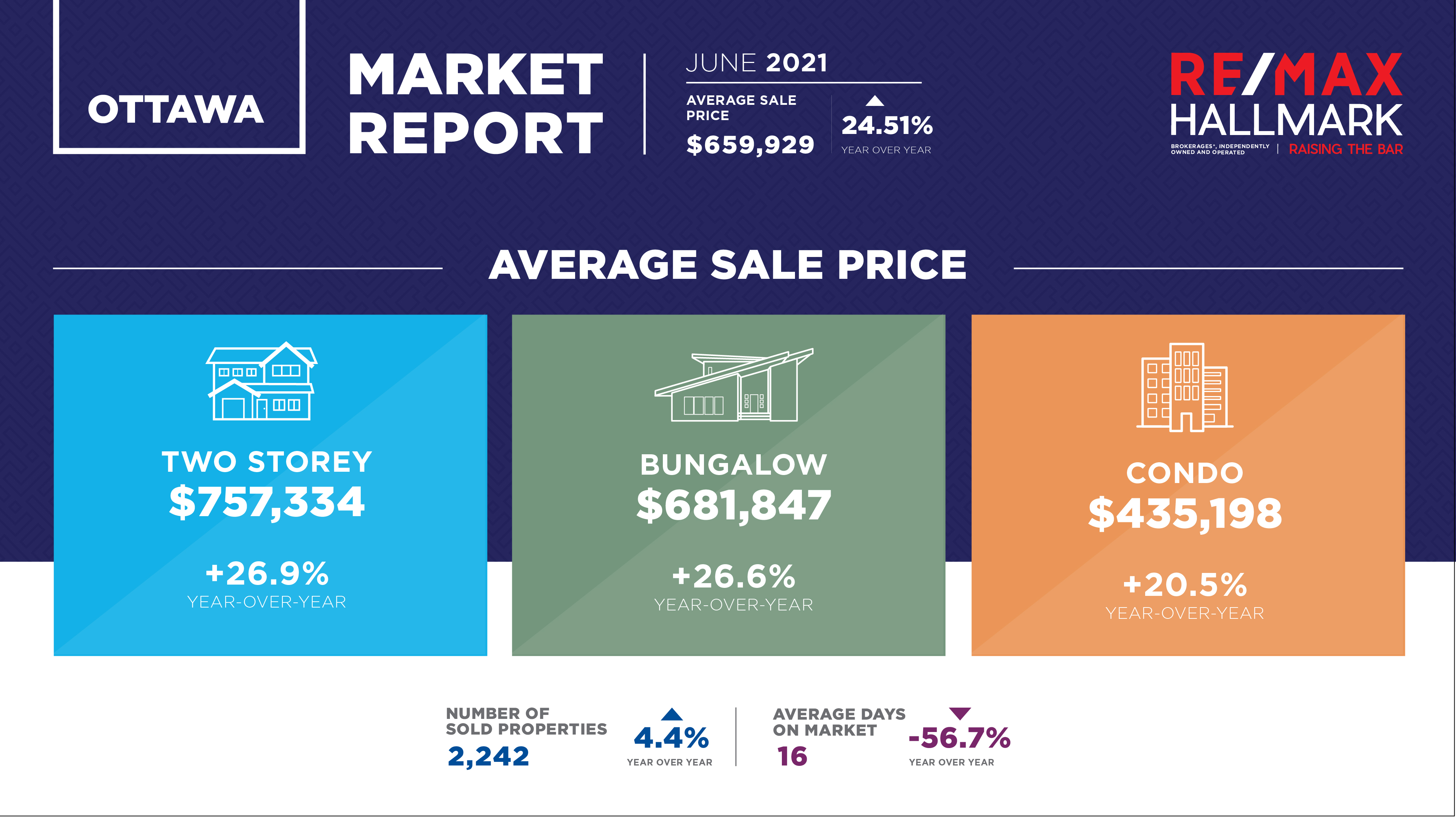
July 2021 - Members of the Ottawa Real Estate Board sold 2,131 residential properties in June through the Board’s Multiple Listing Service® System, compared with 2,038 in June 2020, an increase of 5 per cent. June’s sales included 1,647 in the residential-property class, up 2 per cent from a year ago, and 484 in the condominium-property category, an increase of 13 per cent from June 2020. The five-year average for total unit sales in June is 2,098.


“June’s resale market performed similar to a typical (pre-pandemic) June, with unit sales on par with the five-year average and a lower volume of activity compared to May, particularly in the last two weeks of the month. This is a normal tapering off as families turn their attention to end of school events and enjoying more outdoor recreation. This year, it also coincided with some easing of pandemic restrictions,” states Ottawa Real Estate Board President Debra Wright. “It will be interesting to watch the market over the summer to see if this normalization of the real estate sales ebb and flow is indeed the case moving forward. Last year, summer resales skyrocketed due to pent-up demand when the first lockdown ended.”


“Year-to-date sales are tracking 48% higher than last year at this time with 11,446 properties changing hands and are 16-18% higher than 2018 and 2019. Much of this increase is due to the increased activity in the first five months of 2021 compared to previous years. We have also seen an instrumental increase in new listings this year, and inventory levels for both residential and condominiums are higher than we’ve seen since 2017. However, we are still at a one month supply of housing stock, so we aren’t out of the woods yet.”


June’s average sale price for a condominium-class property was $435,198, an increase of 21 per cent from last year, while the average sale price for a residential-class property was $725,970, an increase of 26 per cent from a year ago.With year-to-date average sale prices at $734,357 for residential and $422,734 for condominiums, these values represent a 33 per cent and 20 percent increase over 2020, respectively.*


“For the moment, there are signs that we’ve reached a levelling out, especially as it relates to average prices which, in recent months, have not experienced the drastic increases of earlier in 2021, nor are we seeing a drop,” notes Wright.

“Properties are not moving as quickly as they were. Inventory has picked up; there is less scarcity and more choices – consequently, less upward pressure on prices. Additionally, we are noticing fewer of the multiple offer frenzy situations. Of course, many properties do still have multiple offers, but our REALTORS® are noticing that there are less of them on offer day.”


“This start of a perhaps equilibrium in the market is good news for Buyers, while Sellers are going to have to adjust to this new normal and be more strategic in their positioning. Whichever side of the transaction you are on, you will bode well by listening and heeding the advice of a professional REALTOR® who has their pulse on the day-to-day variabilities Ottawa’s resale market is experiencing,” Wright suggests.


* OREB cautions that the average sale price can be useful in establishing trends over time but should not be used as an indicator that specific properties have increased or decreased in value. The calculation of the average sale price is based on the total dollar volume of all properties sold. Price will vary from neighbourhood to neighbourhood.

Read

Residential Resale Market: A tale of Two May Lockdowns

Members of the Ottawa Real Estate Board sold 2,296 residential properties in May through the Board’s Multiple Listing Service® System, compared with 1,342 in May 2020, an increase of 71 per cent. May’s sales included 1,779 in the residential-property class, up 67 per cent from a year ago, and 517 in the condominium-property category, an increase of 85 per cent from May 2020. The five-year average for total unit sales in May is 2,123.


“Although Ontario was in a lockdown in both May 2020 and May 2021, the impact they had on Ottawa’s resale market was quite different – with this year’s number of transactions being well over the five-year average. Undoubtedly, enhanced safety measures and vaccine adoption rates have enabled potential Buyers and Sellers to feel more protected and comfortable in their home buying and selling process,” states Ottawa Real Estate Board President, Debra Wright.


“Additionally, twice the number of new listings entered the market in May 2021, compared to last year at this time, with 2,386 residential properties and 727 condos added to inventory. This is approximately 50 units more than the five-year average for new listings,” she adds.


May’s average sale price for a condominium-class property was $424,843, an increase of 24 per cent from last year, while the average sale price for a residential-class property was $741,206, an increase of 35 per cent from a year ago. With year-to-date average sale prices at $736,241 for residential and $420,074 for condominiums, these values represent a 35 per cent and 21 percent increase over 2020, respectively.*


“With the number of condominium sales transactions having increased by 85% in May of 2021, over May of 2020, coupled with the 21% price increase in the same periods, it appears that the condo market has recovered from the declines experienced early in the pandemic.”


“For residential-class properties, price movement is still well above 2020, with 46% selling over $700K compared to 16% of properties last year at this time – these percentages are reflected in the sales data for both May and year-to-date. We observe that month-over-month average price increases for April and May are not as high as the jumps in value in the first quarter of 2021. While it is still too early to predict, this may be a sign that the rapid price acceleration we have been experiencing is easing in the market.”


“As we come out of this lockdown, we will closely monitor other market factors including the effects of the increased stress test measures combined with the average five-year fixed mortgage rates climbing back over two per cent since the beginning of 2021, and whether pent-up supply will decrease our supply shortage and eventually bring Ottawa’s real estate market to a more balanced state,” Wright concludes.

OREB Members also assisted clients with renting 1,837 properties since the beginning of the year compared to 1,207 at this time last year.


* OREB cautions that the average sale price can be useful in establishing trends over time but should not be used as an indicator that specific properties have increased or decreased in value. The calculation of the average sale price is based on the total dollar volume of all properties sold. Price will vary from neighbourhood to neighbourhood.


Read

FEBRUARY RESALES SNAPPED UP QUICKLY

March 2021 ■ Members of the Ottawa Real Estate Board sold 1,390 residential properties in February through the Board’s Multiple Listing Service® System, compared with 1,134 in February 2020, an increase of 23 per cent. February’s sales included 1,028 in the residential-property class, up 24 per cent from a year ago, and 362 in the condominium-property category, an increase of 19 per cent from February 2020. The five-year average for total unit sales in February is 1,101.


“Resale properties are virtually flying off the shelves,” states OREB President Debra Wright. “Even though our inventory is significantly lower than 2020 – a combined 46% decrease in housing stock for residential and condos – we witnessed a record number of sales in February 2021. How is that possible? Simply put, properties that come onto the market are selling very quickly.”


“With less than a month’s supply in both categories, residential homes, in particular, are experiencing the quickest turnarounds. This is evidenced in the sharp decline of Days on Market from 30 days in February 2020 to 14 days last month. Interestingly, DOM for the condo market has gone up slightly from 19 to 22 days, likely due to the fact that the condo market was thriving and moving very quickly prior to the pandemic spread in Canada. We saw Buyer desire for more house space dampen that market temporarily; however, it is clear the condo market has stabilized and is starting to rebound with a 19% increase in transactions compared to last year at this time.”


February’s average sale price for a condominium-class property was $407,671, an increase of 17 per cent from last year, while the average sale price of a residential-class property was $717,914, an increase of 27 per cent from a year ago.With year-to-date average sale prices at $701,778 for residential and $395,496 for condominiums, these values represent a 29 per cent and 15 percent increase over 2020, respectively.*


“With supply constraints continuing to place upward pressure on pricing, there is no doubt that this economic fundamental is driving the price increases. This is also reflected in February’s total sales volume for residential and condos, which combined was at $885,592,105, 54% higher than the same month in 2020. There is no denying that scarcity is leading to a more rapid price acceleration. This scarcity combined with Buyers’ willingness to pay and compete in this market will continue to drive up the sales prices,” Wright asserts.


“The upcoming spring market will bring more listings and increased inventory; however, the question is whether it will be enough to meet demand. Having a sound strategy, whether you are buying or selling, is the key to success. In this complex and fast-paced market, it is essential to utilize the skills and experience of a REALTOR® with negotiation skills and the market knowledge to act quickly on your behalf.”


“Did you know they also help tenants locate rental accommodations in addition to assisting landlords in finding tenants? Ottawa’s vacancy rates have soared due to the lack of immigration, visiting student populations, decline in Airbnb, etc. There are many good quality rentals out there, and a REALTOR® can help you find one whether you are selling and prefer to rent or searching for a different location,” Wright concludes.


* The Board cautions that the average sale price can be useful in establishing trends over time but should not be used as an indicator that specific properties have increased or decreased in value. The calculation of the average sale price is based on the total dollar volume of all properties sold. Price and conditions will vary from neighbourhood to neighbourhood.

Read

OTTAWA’S RESALE MARKET THRIVES DESPITE PANDEMIC

January 2021 ■ Members of the Ottawa Real Estate Board (OREB) sold 1,002 residential properties in December through the Board’s Multiple Listing Service® System, compared with 757 in December 2019, an increase of 32.4 per cent. December’s sales included 710 in the residential property class, up 33.7 per cent from a year ago, and 292 in the condominium property class, an increase of 29.2 per cent from December 2019. The five-year average for total residential unit sales in December is 779.


“Our market performance in December capped off a year for resales that clearly shows a market that continued to thrive even through the challenges of 2020. December sales brought our year-to-date numbers at year-end to within 2% of 2019. There was a slight slowdown typical of December around the holiday season; however, the market continued its overall momentum and remained more active than usual,” states Ottawa Real Estate Board’s 2021 President Debra Wright.


“At the start of the pandemic, we didn’t know what to expect. We had a momentary stall as did most businesses; however, once real estate was deemed to be an essential service, REALTORS® worked with Buyers and Sellers to ensure safety in the process, and the market picked back up and accelerated past all expectations throughout the remainder of the year.” The total number of residential and condo units sold throughout 2020 was 18,971, compared with 18,613 in 2019, increasing 2 per cent. Residential property class unit sales went up by 3 per cent, with 14,455 properties exchanging hands last year compared to 14,030 in 2019. Condominium property class sales decreased slightly by 1.5 per cent, with 4,516 units sold in 2020 versus 4,583 in the previous year. Year-end figures show an average sale price of $582,267 for residential-class properties and $361,337 for condominium units in 2020. These values represent a 20 per cent and 19 percent increase over 2019, respectively.*


“When analyzing the year-end figures, what clearly stood out was that although the number of units sold was only slightly higher than last year, the Total Sales Volume topped a record-breaking $10 billion compared to $8.2 billion at the end of 2019. This is, in effect, a stark illustration of the increase in Ottawa property values over the course of the year. For example, in 2019, 35% of properties purchased were sold at or below $400K, while in 2020, only 16% of homes were. The market is certainly exhibiting a major shift in terms of availability in lower price ranges,” Wright points out.


“At the end of 2020, average prices increased by 19-20% over this time last year. In 2019, we saw a 9% overall increase for both residential and condo properties compared to 3-5% in 2018 and 3-7% in 2017. These substantive increases in property prices from year to year can be attributed to a variety of factors: the inventory shortage triggering economic supply and demand realities, the multiple-offer phenomena, the record-low mortgage rates increasing purchasing power of Buyers, migration of Buyers from larger markets with high returns to spend, and so forth.”


“I believe that Ottawa is just coming into its own as a national capital city. As such, it is resilient and sheltered in a way that other markets are not – with consistent government and tech sector employment that is particularly conducive to working from home as our current circumstances have required. We may have been privileged with lower price thresholds in previous decades, but perhaps the market is now beginning to reflect the real estate property values of a national capital.” “Going forward, I fully expect Ottawa’s resale market will continue to be robust in 2021. There are no indicators to suggest that this is an overheated market – it is simply very active, insulated, and strong. One that has only been mildly shaken by a world-wide pandemic,” Wright concludes.

Read

No Signs of Slowdown in Ottawa Resale Market

December 2020 - Members of the Ottawa Real Estate Board sold 1,611 residential properties in November through the Board’s Multiple Listing Service® System, compared with 1,284 in November 2019, a year over year increase of 26 per cent. November’s sales included 1,209 in the residential-property class, up 27 per cent from a year ago, and 402 in the condominium-property category, an increase of 23 per cent from November 2019. The five-year average for November unit sales is 1,257.


“We continue to experience strong activity in Ottawa’s resale market during the time of year when we would typically see a slowdown,” states Ottawa Real Estate Board President Deb Burgoyne. “Further, the pandemic overall did not slow down the resale market, and our year to date transactions are now on par with 2019.”


“I’m confident in saying that if we had more supply, sales would be even higher. Although new listings were up almost 400 units compared to last November and over 225 properties higher than the five-year average, there were 1,000 fewer new listings entering the market than we saw in October. Listings coming on in November do typically slow as potential Sellers turn their attention to the upcoming holiday season,” Burgoyne adds.


November’s average sale price for a condominium-class property was $361,758, an increase of 15 per cent from this time last year, while the average sale price of a residential-class property was $602,892, an increase of 20 per cent from a year ago. With year-to-date average sale prices at $581,120 for residential and $361,674 for condominiums, these values represent a 20 per cent and 19 percent increase over 2019, respectively.*


“As far as average prices go, year to date prices are a more reliable indicator of what property values are doing over time, especially when we look at figures from the final quarter of the year. In November 2018, we saw a 3-5% gain in YTD average prices; a year later in 2019, they were up 9% for both property classes. Now in 2020, YTD average prices are 19-20% higher. This trajectory can be attributed to a concurrent decrease in inventory, which continues to be a challenge in our active market. The residential housing stock is 50% lower than last year at this time.”


“Interestingly, the number of condominiums on our MLS® System has actually increased 25% over last November,” Burgoyne notes. “As I stated last month, condos continue to be on our watchlist. This property type is staying on the market longer. The increase in these listings is likely a combination of factors. Investor owners who have been renting their units can now capitalize on the robust market, while some Buyers are seeking more space or other lifestyle options. For example, transitioning to working remotely is providing some Buyers with the opportunity to explore their lifestyle property preferences. Whether it be small town vs downtown living, a recreational property with acreage, be closer to golf courses or waterfront, rural spaces or hobby farms – it opens up the options beyond the classic property types of condominiums or single-family homes in suburbia.”


“Now more than ever, Buyers and Sellers will benefit from the knowledge and experience of a REALTOR®. Our resale market continues to experience multiple offers and bidding wars, and you would want the guidance of someone who has maneuvered through this many times. Particularly if you are looking at purchasing a recreational property, which have become very desirable in the past 6 months or so. These properties’ considerations are different than those you are used to seeing in the city, such as wells, septic tanks, conservation considerations, etc. A professional REALTOR® can explain these features to you, so you don’t risk any surprises down the road,” Burgoyne cautions.


In addition to residential and condominium sales, OREB Members assisted clients with renting 3,120 properties since the beginning of the year compared to 2,559 at this time last year.


* The Board cautions that the average sale price can be useful in establishing trends over time but should not be used as an indicator that specific properties have increased or decreased in value. The calculation of the average sale price is based on the total dollar volume of all properties sold. Price and conditions will vary from neighbourhood to neighbourhood.

Read
The trademarks REALTOR®, REALTORS®, and the REALTOR® logo are controlled by The Canadian Real Estate Association (CREA) and identify real estate professionals who are member’s of CREA. The trademarks MLS®, Multiple Listing Service® and the associated logos are owned by CREA and identify the quality of services provided by real estate professionals who are members of CREA. Used under license.